

Choosing between total ankle replacement and ankle fusion depends on your age, activity level, and bone quality. Total ankle replacement preserves motion and suits active patients with good bone stock. Ankle fusion eliminates pain by stabilizing the joint and suits patients with severe deformity or poor bone quality. At Leroy Butler, DO PLLC, we evaluate these factors to determine the best surgical path for your specific anatomy.
Total Ankle Replacement
Total ankle replacement is a surgical procedure that replaces the damaged talocrural joint with a prosthetic implant. This technique aims to restore normal range of motion while eliminating arthritis pain. The procedure is generally recommended for patients who are younger, more active, and have sufficient bone density to support the implant. It allows for a more natural gait pattern compared to fusion. However, the implant has a limited lifespan and may require revision surgery in the future. Patients must adhere to strict weight-bearing restrictions during the initial healing phase to ensure the implant integrates correctly.
Strengths and Limitations
The primary strength of total ankle replacement is the preservation of joint mobility. Patients often report a more comfortable walking experience and less stress on adjacent joints. The limitation is the long-term durability of the prosthesis. If the bone quality is poor, the implant may loosen or fail. Additionally, the surgery is technically demanding and requires a surgeon with specific fellowship training in foot and ankle surgery. At Leroy Butler, DO PLLC, we carefully assess bone quality and alignment before recommending this option.
Ankle Fusion
Ankle fusion is a surgical procedure that joins the tibia and talus bones together to create a single, solid bone. This eliminates motion in the ankle joint, which removes the source of arthritic pain. The procedure is highly reliable and has a long track record of success. It is often the preferred choice for patients with severe joint deformity, significant bone loss, or a history of failed previous surgeries. While the ankle no longer moves, the foot can still bend at the midfoot and forefoot, allowing for functional walking. The main trade-off is among the loss of ankle dorsiflexion and plantarflexion.
Strengths and Limitations
The greatest strength of ankle fusion is its durability. A successful fusion typically lasts a lifetime without the need for implant replacement. It is also a robust option for patients with complex anatomy that makes implant placement difficult. The limitation is the permanent loss of ankle motion. Some patients may experience increased stress on the knee or hip over time. Recovery involves a period of non-weight-bearing, similar to replacement, but the final result is a stable, pain-free joint. We discuss these trade-offs thoroughly during your consultation at Leroy Butler, DO PLLC.
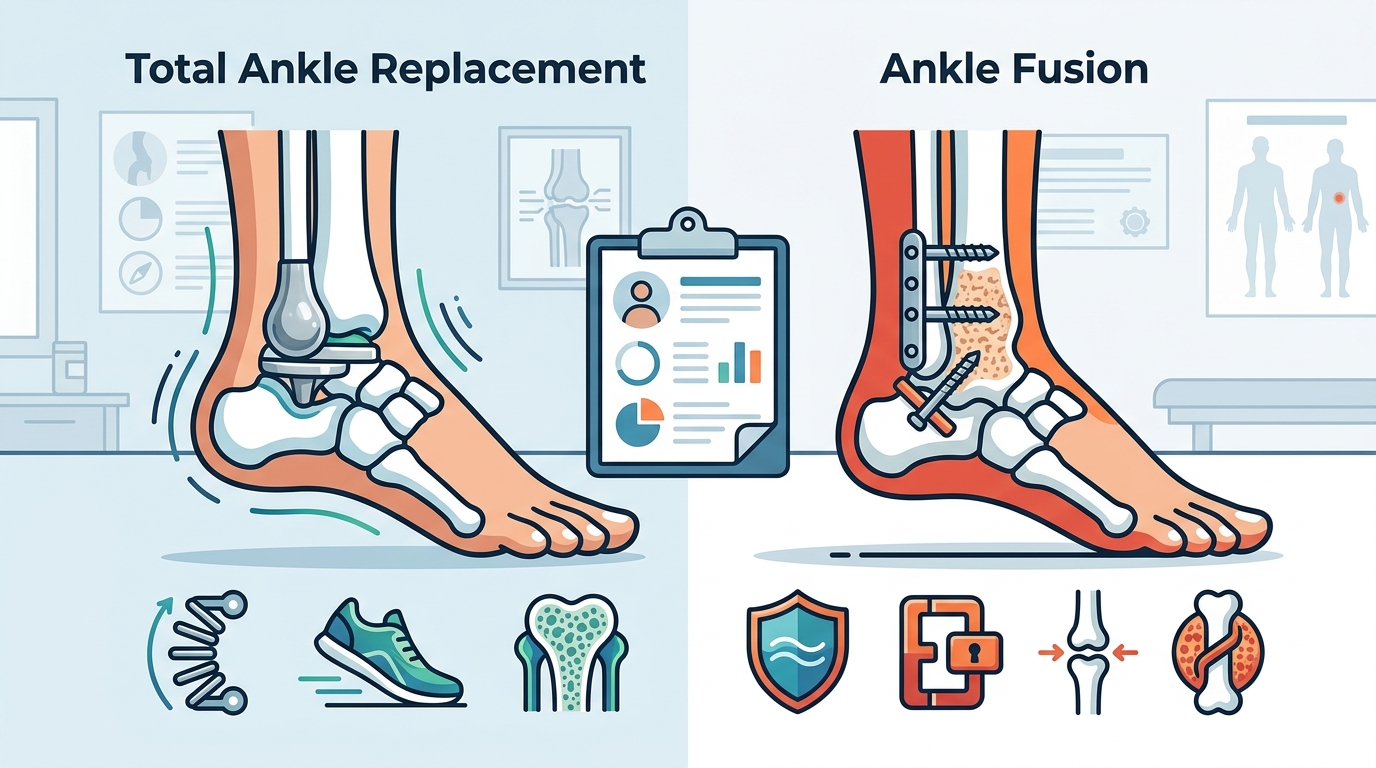
Surgical Comparison Table
| Criteria | Total Ankle Replacement | Ankle Fusion |
|---|---|---|
| Joint Motion | Preserved | Eliminated |
| Long-Term Durability | Implant lifespan limited | Lifetime stability |
| Ideal Candidate | Active, good bone quality | Severe deformity, poor bone |
| Revision Risk | Higher if implant fails | Lower if fusion solid |
| Recovery Focus | Protecting implant | Ensuring bone union |
Choosing the Right Procedure
The decision between these two surgeries is not one-size-fits-all. It requires a detailed evaluation of your specific condition. Choose total ankle replacement if you are relatively young, have good bone density, and wish to maintain a natural range of motion. This option is often suitable for patients who want to remain active in low-impact activities. Choose ankle fusion if you have severe arthritis with significant joint deformity, or if you have had previous ankle surgeries that compromised the bone structure. Fusion provides a definitive solution for pain relief in these complex cases. At Leroy Butler, DO PLLC, we use advanced imaging to determine which option offers the best long-term outcome for your unique anatomy.
Frequently Asked Questions
Can I switch from fusion to replacement later?
It is generally difficult to convert a fused ankle to a replacement. Once the bones are fused, the anatomy required for an implant is often no longer present. Replacement is usually the first-line option for suitable candidates, while fusion is reserved for those who are not candidates for replacement.
How long does recovery take for each surgery?
Both procedures require a period of non-weight-bearing, typically lasting six to eight weeks. Full recovery and return to normal activities can take several months. The timeline is similar for both, but the focus of rehabilitation differs based on the specific surgical goal.
Is total ankle replacement suitable for older patients?
Age alone is not the deciding factor. Bone quality and activity level are more important. Many older patients are excellent candidates for replacement if their bone density is sufficient. We evaluate these factors individually during your consultation.
What are the risks of implant failure?
Implant failure can occur due to loosening, wear, or infection. The risk is higher in patients with poor bone quality or those who do not adhere to weight-bearing restrictions. Regular follow-up appointments are essential to monitor the implant's status.
Does ankle fusion affect other joints?
Yes, the loss of ankle motion can increase stress on the knee and hip. However, most patients adapt well and maintain a functional gait. The pain relief from fusion often outweighs the biomechanical changes for many patients.
Next Steps
If you are struggling with ankle pain and considering surgical options, a professional evaluation is the best next step. At Leroy Butler, DO PLLC, we provide comprehensive care for foot and ankle conditions in Dallas and Frisco. to schedule a consultation and discuss which procedure is right for you.