

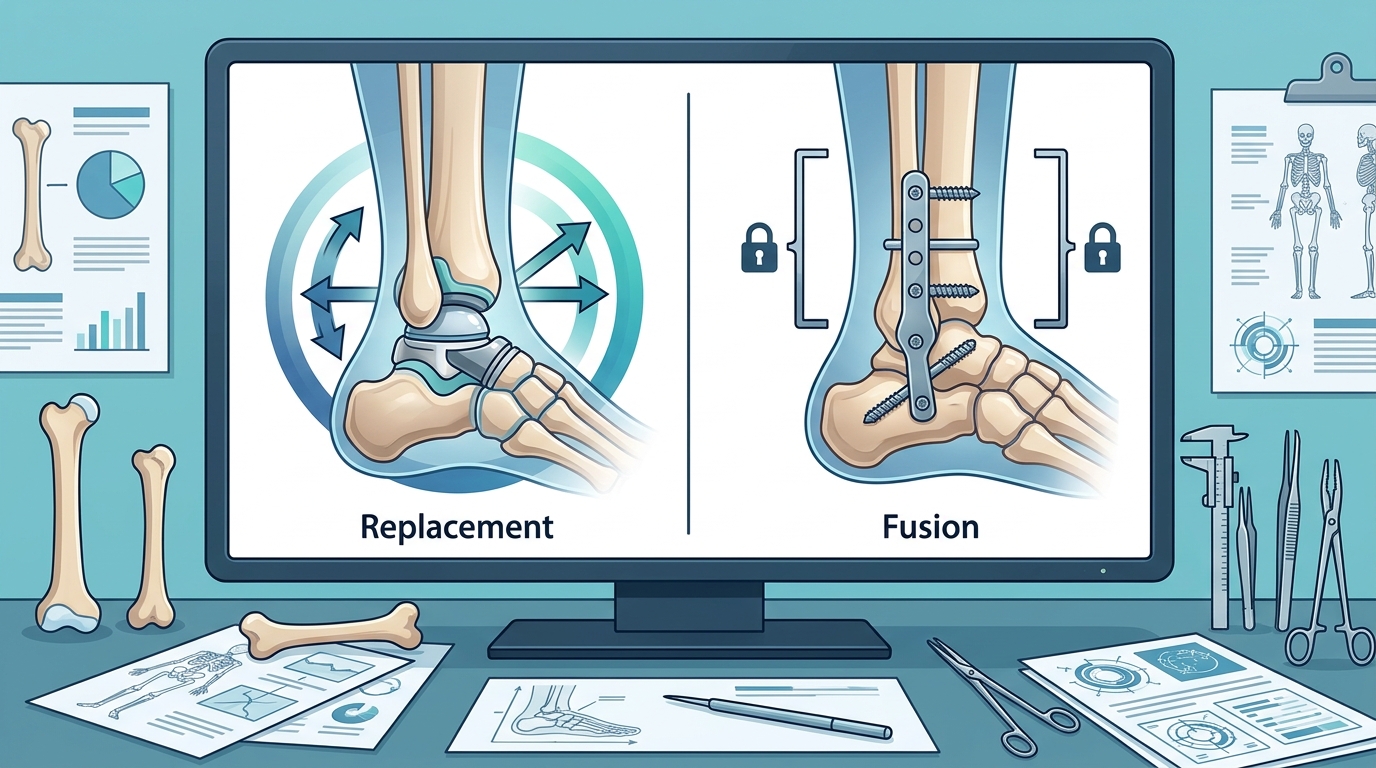
Patients with advanced ankle arthritis often face a difficult decision between joint replacement and joint fusion. Total ankle replacement is a surgical procedure that replaces the damaged joint surfaces with metal and plastic components to restore motion. Ankle fusion is a procedure that joins the bones of the ankle together to eliminate pain but permanently stops movement. At Leroy Butler, DO PLLC, we help patients in Dallas and Frisco understand these options to make informed decisions about their mobility and long-term quality of life.
1. Preservation of Natural Ankle Motion
Replacement allows you to keep the natural bending and rolling of the ankle. Fusion eliminates all motion at the joint, which can make walking feel stiff and unnatural. Total ankle replacement aims to restore a range of motion that closely mimics the healthy ankle. This preservation of movement is often the primary reason patients prefer replacement over fusion.
2. Improved Walking Mechanics and Comfort
Patients often report a more natural gait and less fatigue after replacement. Because the joint moves, the foot can roll and adapt to uneven surfaces more easily than a fused ankle. This can reduce the strain on the knee, hip, and lower back that often develops when the ankle is immobilized. Comfort during daily activities is a significant factor in patient satisfaction.
3. Lower Risk of Adjacent Joint Degeneration
Keeping the ankle mobile may protect the joints above it from excess wear. When an ankle is fused, the forces of walking are transferred to the subtalar joint and the knee. Over time, this increased stress can lead to arthritis in those neighboring joints. By maintaining motion, total ankle replacement helps distribute forces more naturally across the lower limb.
4. Faster Initial Recovery for Many Patients
Replacement often allows for earlier weight-bearing and mobility than fusion. While both surgeries require a period of healing, many patients undergoing replacement can begin moving the ankle sooner. This can translate to a quicker return to daily activities and less time in a cast or boot. The specific recovery timeline depends on the individual patient and the surgeon's protocol.
5. Reversibility of the Procedure
Replacement is a reversible option, whereas fusion is permanent. If a total ankle replacement fails or wears out, it can be revised to a new implant. If a fusion is performed, the bones have grown together and cannot be easily separated to restore motion. This reversibility provides a safety net for patients who may need future interventions.
6. Better Outcomes for Specific Patient Profiles
Replacement is often ideal for patients with good bone quality and stable ligaments. Candidates for replacement typically have arthritis limited to the ankle joint without severe deformity or instability. Fusion may be a better choice for patients with severe bone loss, high activity levels, or significant deformity. A thorough evaluation helps determine which procedure fits your specific anatomy.
7. Enhanced Quality of Life and Function
Many patients report higher satisfaction scores with replacement due to retained function. The ability to walk, climb stairs, and perform daily tasks with a moving ankle contributes to a better overall quality of life. While both procedures effectively reduce pain, the functional benefits of motion preservation are a key differentiator. Patient-reported outcomes often reflect this preference for mobility.
Choosing the Right Option for You
The decision between total ankle replacement and fusion depends on your specific anatomy, activity level, and health goals. There is no one-size-fits-all answer, and the best choice is determined through a detailed clinical evaluation. At Leroy Butler, DO PLLC, we provide personalized guidance to help you understand which option aligns with your lifestyle and long-term health. To discuss your case, contact our team to schedule a consultation.
Frequently Asked Questions
Is total ankle replacement a permanent solution?
Total ankle replacement is a long-term solution, but the implant has a lifespan. Like any mechanical device, it can wear out over time. However, if it does fail, it can be revised with a new implant, unlike a fusion which is permanent.
Who is a good candidate for total ankle replacement?
Good candidates typically have arthritis in the ankle joint, good bone quality, and stable ligaments. They should not have severe deformity or active infection. A surgeon will evaluate your specific anatomy to determine eligibility.
How long does recovery take after total ankle replacement?
Recovery varies, but most patients can bear weight with a boot within a few weeks. Full recovery and return to normal activities can take several months. Physical therapy is a crucial part of the rehabilitation process.
Can I run after total ankle replacement?
What is the difference between fusion and replacement in terms of pain relief?
Both procedures are effective at relieving pain. Fusion eliminates pain by stopping motion, while replacement relieves pain by removing the damaged cartilage and bone. The choice often comes down to the desire to retain motion versus the need for a more robust, motionless joint.